

Robot Updates #3
What's happening around the home, in the factory, and (crazy) on the tennis court.

Welcome to Robot Updates #3, where I catch you up on the latest news about our future robot overlords (mostly kidding).
You may have noticed that there was no AI Updates newsletter last week. Sorry about that, unfortunately I wasn’t able to finish it in time, but next month’s will be extra interesting to make up for it.
Alright, let’s dive in.
Just replace “scientific breakthroughs” with Robotics. We haven’t reached that sci-fi future of ubiquitous robots yet, but each little step gets us closer.

New and Notable
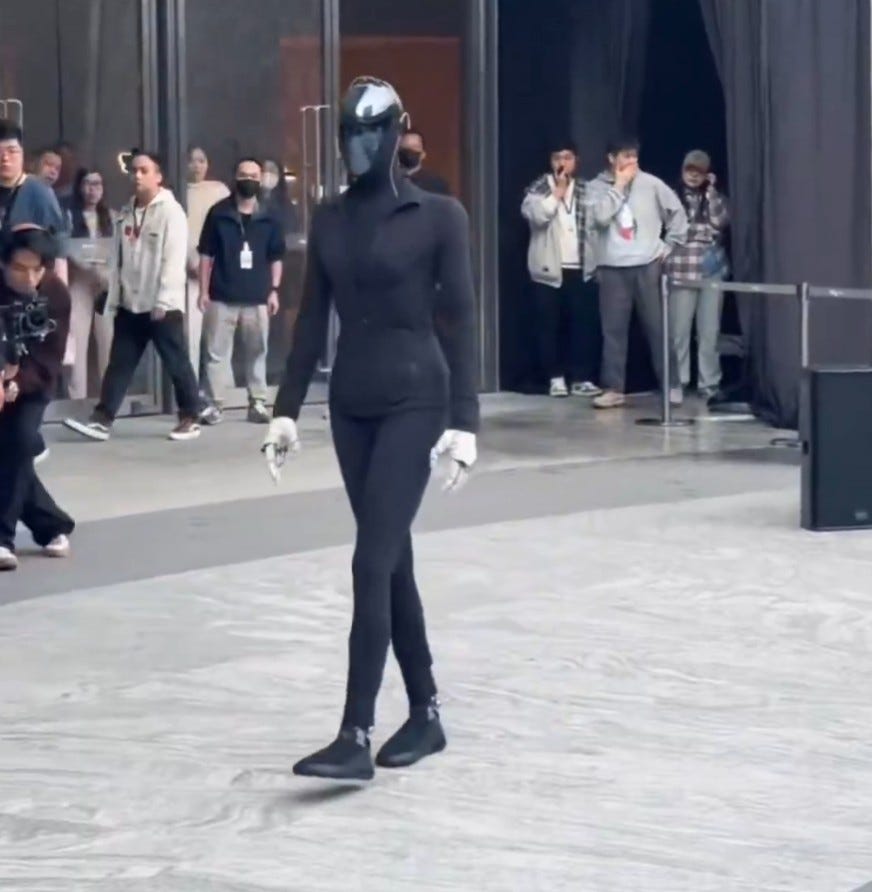
XPENG’s New Iron humanoid looks pretty impressive just taking a walk. Multiple companies are really mastering a more natural gait. Though apparently it crashed shortly after this segment of video, so not perfect yet.

It was inevitable really. Give this short clip a watch, it shows China’s army “training for robot and drone warfare.” Dozens of unmanned ground robots and drones were used, with the focus being on “speed, saturation, & AI-decisions.”
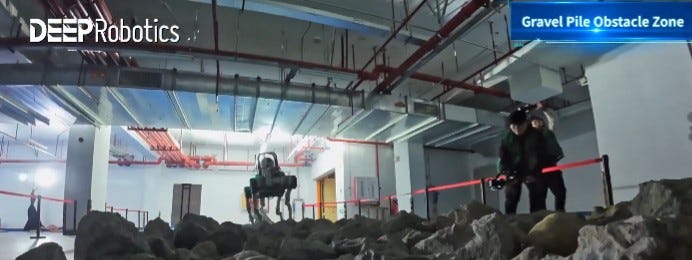
Thankfully, warfare isn’t the only use case. Search and rescue is going to benefit immensely for better robots, as this Deep Robotics quadruped demonstrates.
Ginko Bioworks CEO Jason Kelly recently gave a talk on their plan to build autonomous robotic laboratories, with the goal being to replace manual ones in the next 5 years. Ambitious? Absolutely, and maybe a little aspirational on their timeline. But their idea and direction is probably mostly correct.


There’s a new “Roomba” in town. The Roborock Saros Rover isn’t from Roomba, but it’s basically a Roomba with legs, which falls into the cute and possibly useful category, as now it can get itself unstuck more easily, and climb and clean stairs.

NVDIA has launched Isaac GR00T N1.6, “an open reasoning vision language action (VLA) model, purpose-built for humanoid robots, that unlocks full body control and uses NVIDIA Cosmos Reason for better reasoning and contextual understanding.” Basically, this is for training the robots, and because it’s NVIDIA I’m sure it’ll be extremely effective.
China just isn’t slowing down in robotics. Check out this video here of a solar powered robot clearing ice by gliding “along a power transmission line at an altitude of 3,300 meters in Sichuan Province, southwest China.” Here’s another interesting one of robots from LimX Dymamics unboxing themselves. And UBTech’s Walker S2 playing tennis with a human.
In the Home
Figure Robotics has just taken a big step forward with their Helix 02, saying that “It’s our most powerful model to date - it’s using the whole body to do dishes end-to-end and it’s fully autonomous.” It’s not at Jetsons level yet, but it’s well on the way, and by far the closest I’ve seen.
American company Fauna Robotics has released their humanoid called Sprout. It looks more like something created by Disney than The Terminator, which is always nice to see. I figure it’s a good sign that kids are putting stickers on it.
Another American player designing humanoid robots for home use is 1x, and their NEO model is starting to be able to learn new tasks on its own by doing them.
In the Factory
Hyundai Motor Group’s union has declared “not a single robot will be allowed onto the factory floor without a labor-management agreement,” making it the first union at a global automaker to openly oppose humanoid robots on production lines. The standoff erupted after Hyundai unveiled plans at CES 2026 to deploy Boston Dynamics’ Atlas humanoid robots starting in 2028 at its Georgia plant, with the robots able to handle complex tasks by 2030. The union estimates that three workers running 24-hour shifts cost about $208,200 total annually, while a humanoid robot requires only maintenance and electricity after purchase—creating an economic incentive toward labor replacement that union leaders call an “employment shock.” I hate to say it, but I think they’re fighting against an inevitability that will eventually replace almost all humans in factory work. In the long run, that’s probably a good thing, but in the short to medium term it really is going to be disruptive—to put it mildly. Those Boston Dynamics humanoid robots, the plan is to produce 30,000 of them in 2026. That’s going to start making an impact sooner rather than later.
They aren’t the only one, with UBTech’s Walker S2 humanoid robots starting to make inroads into factories as well. The robots currently match just 30-50% of human productivity and only in specific tasks like stacking boxes and quality control, according to chief brand officer Michael Tam. Yet manufacturers including BYD and Foxconn are racing to order them anyway, driven by first-mover advantage fears. UBTech aims to boost Walker’s performance to 80% of human efficiency by 2027 and scale from 500 units delivered in 2025 to 10,000 in 2026, with analysts noting that 80% might suffice since robots don’t need breaks or holidays, just maintenance. The bet isn’t on perfect robots today—it’s on learning faster than competitors while the technology matures. UBTech has also “reached a new agreement with European aviation leader Airbus to supply robots for use inside aircraft manufacturing facilities,” so these robots obviously have broad appeal in factory settings.
Recommendations

I came across this essay on robotics that’s really quite excellent, well worth a read. Though it wouldn’t hurt to try and put it into some sort of auto reader, as it is rather long. As the author says, “Spend an hour reading this weekend and I think you’ll know more about robotics than 99% of people, including some people who invest in robotics.”
That’s it for now, but Robot Updates will be back in your inboxes next month. Thank you all for reading—and until next time, keep your eyes on the horizon.
-Owen
This piece really made me think, what if that Ginko Bioworks timeline really holds, imagine the exponential acceleration of scientific progress.
Another great round-up.
If you have ever seen the movie iRobot, you might remember that the film takes place in 2035. It’s a semi-futurist world of AI supercomputers, autonomous vehicles, and mass adoption of robots…they still didn’t foresee the smartphone.
The timing of the technologies depicted in that film is looking increasingly prescient….
I just hope Grok doesn’t turn out like VIKI