

Techno-Optimist #21
NVIDIA announces personal supercomputer, the carbon in your body probably spent time outside the galaxy, chip design gets crazy, underground nuclear power plants...and a whole lot more.

Welcome to the twenty-first edition of Techno-Optimist, your go-to destination for all the latest updates and commentary on space, science, technology, medicine, energy, AI, and much more. Thank you all for understanding the abbreviated newsletter last Saturday. Here below is what I wanted to write, but wasn’t able to. Hope you enjoy, and remember that edition #22 will be out next Saturday on the usual schedule. I don’t want to hype it up too much, but I think it’s going to be a real banger.
It sounds like things are maybe improving a little with the LA fires? But if you live in or around LA (or San Diego now sounds like), please stay safe! On that note, I was encouraged to see that Palmer Luckey—founder of Anduril—has registered to compete in the ‘Wildfire XPRIZE,’ which has as its goal eliminating destructive wildfires by developing and deploying technology “that can autonomously detect and extinguish wildfires over thousands of square miles in less than 10 minutes.” I honestly haven’t the foggiest idea how that could be done; but as a certain stranded Martian astronaut once said, “So in the face of overwhelming odds, I'm left with only one option: I’m going to have to science the shit out of this.”
Alright, let’s dive in.
"One of the ultimate goals of science is mastery over nature, for the benefit of mankind." —Owen Lewis
Inspired by the following:
“The true and lawful goal of the sciences is none other than this: that human life be endowed with new discoveries and powers.” —Francis Bacon
“By this means, knowing the force and actions of fire, water, air, the stars, the heavens, and all other bodies that surround us…we can employ them in all the uses to which they are appropriate, and thus make ourselves, as it were, masters and possessors of nature.” —René Descartes
CES 2025. This year’s Consumer Electronic Show ran from Jan 7th to 10th in Las Vegas, and boy oh boy did they have some cool stuff there this year! Here’s a bunch of the highlights:

NVIDIA announced a personal AI supercomputer, a project they call DIGITS. At a cost of $3,000 it can handle AI models with 200 billion parameters, “Placing an AI supercomputer on the desks of every data scientist, AI researcher and student empowers them to engage and shape the age of AI.” (NVIDIA) (Dr Singularity)
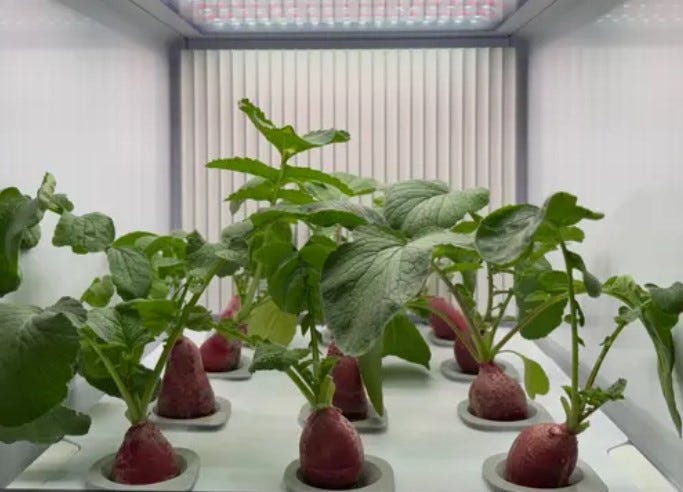
South Korean Daedong is using an AI plant box to “automate plant monitoring to optimize growth conditions.” Based on the picture, it looks like you can grow a lot more than leafy greens too. I definitely want to try this one out. (Interesting Engineering)
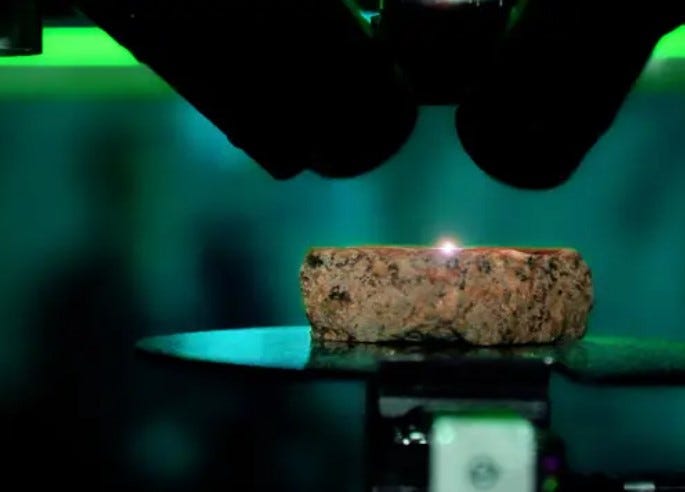
A new microscope built by French startup Ablatom “can reveal the atomic composition of materials in just milliseconds,” using “cutting-edge laser technology to automatically identify atoms.” An important for building a practical tricorder? (Interesting Engineering)

Japanese company Space Walker wants to build “Japan’s first private spaceplane, the Eco Rocket.” They plan to have the first test flights next year. (Interesting Engineering)

Swippitt: “A toaster-like device that charges your phone in seconds!” (Poonam Soni)

Have a look at OMNIA, a 360° body-scanning health mirror, that checks your heart, lung, sleep, overall body and metabolic composition. No launch date yet. (Ritwik Pavan)

Halliday Glasses: “These glasses are equipped with an AI agent that can listen to conversations, answer questions during meetings, and do live translation.” They actually look like normal glasses. (Hamza Khalid)
Here’s some more:
Beetle-inspired air-to-water device from US makes 2.5 gallons of water per day
China’s Cybertruck-like aircraft [drone] carrier makes global debut, secures over 3,000 orders
The new Mercedes G-Wagon EV that lets you turn 360 degrees.
Full body haptic suit for video games. Ready Player One?
Omi: This ‘brain-reading’ wearable could know your thoughts, help flirt, ace exams
“Roomba” with arm to pick up clothes and trash.
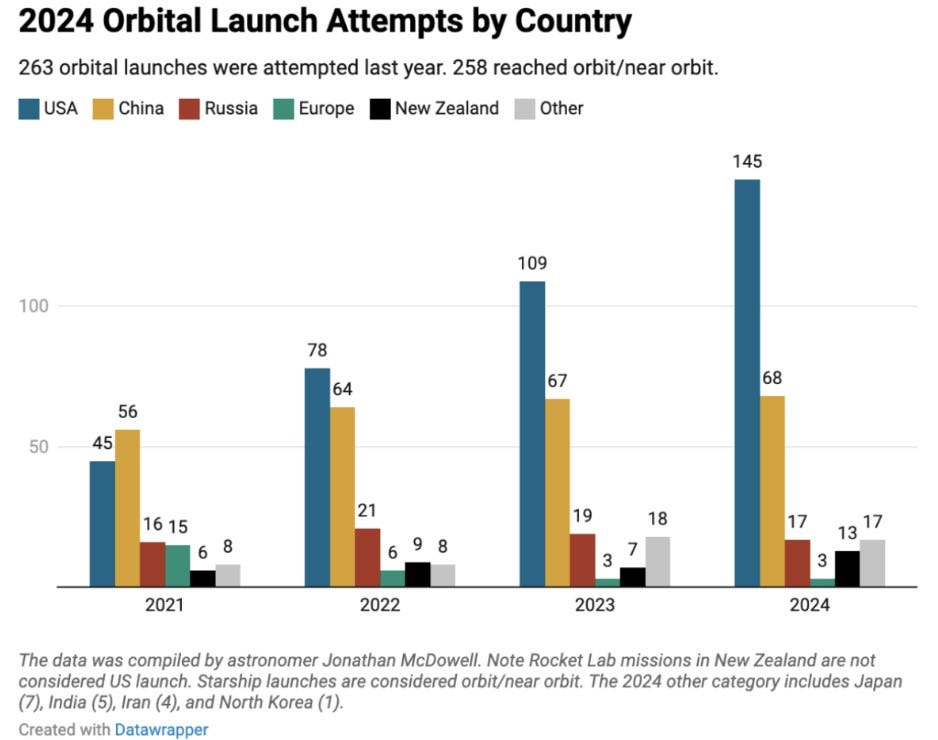
What to expect in space for 2025. A few highlights. First off, have a look at the number of global launches in 2024. America dominated of course, and by America, I mean SpaceX, which accounted for 95% of US launches. 2025 should see an even higher number of global launches. Might we break 300? Rocket Lab’s Neutron rocket could make its debut this year, as could the Nova rocket from Stoke Space. My personal favorite here of course is that SpaceX currently has approval for 25 Starship launches in 2025. Will they use them all? I’d bet probably not, but it also wouldn’t surprise me if they get close.


The most exciting news in January is definitely that two private companies have landers en route to the Moon. ispace’s Resilience lunar lander, and Firefly’s Blue Ghost Mission 1 were both launched on a Falcon 9 earlier this month, and plan to land on the Moon around the middle of the year, and in early March respectively. They’ll be joined by Intuitive Machines’ IM-2 mission, which could launch late February and intends to hunt for volatiles on the Lunar surface. Amazingly, that’s not even it for private missions to the Moon: Astrobotic’s Griffin lander aims to launch sometime in the fall, and it’s entirely possible Blue Origin could send a lander, and Intuitive Machines might even send a second one. After so many years of not much happening on the Lunar surface, it’s nice to see all the activity.
Other notables include Sierra Space finally planning to launch Dream Chaser—their space plane, like a mini-shuttle. Aspiring space station builder Vast intends to launch its commercial space station, Haven-1, in what could be the first step beyond the International Space Station. (Payload 1) (Payload 2) (Space.com)
Last but not least, here’s a great article on the 25 biggest accomplishments in space during the last quarter century [sidebar: yes, I know the first quarter of the 21st century isn’t actually over until the end of 2025], covering everything from the Parker Solar Probe and James Webb Space Telescope, to the detection of gravitational waves and the start of a continuous (robotic) presence on Mars. (Ars Technica)
Carbon intergalactic conveyor belt. Carbon is one of the elements vital to life, and as I’m sure many of you know, it’s formed in the hearts of stars, and then scattered through the cosmos when those stars die. But according to new research, it doesn’t just float around until it ends up in a newly forming star system. Galaxies like ours with active star formation have currents called the circumgalactic medium, that “resemble giant conveyer belts that push material out and draw it back” into the galaxy again. Many of the heavier elements like carbon spend some time outside their home galaxy on this conveyor belt, before being pulled back in to become part of the next generation of stars (and their planets). As one of the astronomers on the project noted, “The same carbon in our bodies most likely spent a significant amount of time outside of the galaxy!”
They based their evidence on spectrographic analysis of distant quasars by the Hubble Space Telescope—looking at how their light “was being absorbed by a specific component of the circumgalactic medium: carbon, and lots of it.” For some galaxies, they found carbon close to 400,000 light years (about 4x the diameter of our Milky Way) out into intergalactic space. Future research will involve searching for other elements in the circumgalactic medium of distant galaxies, and comparing how compositions differ from galaxy to galaxy. (University of Washington)
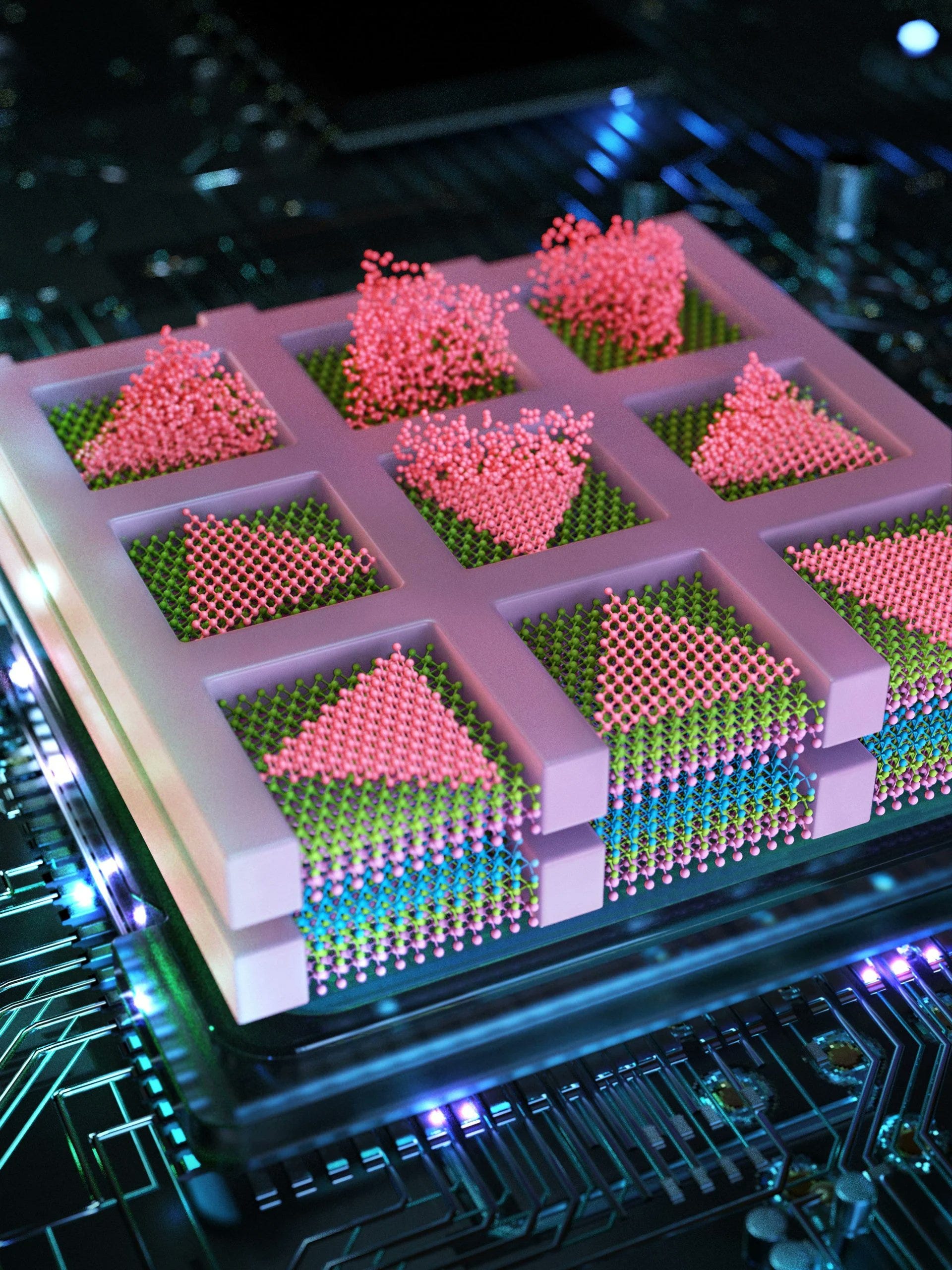
Chip design. MIT engineers have created denser, faster, more powerful computer chips, all part of allowing Moore’s Law to continue. They did it by “developing a method to seamlessly stack electronic layers,” leading to a breakthrough that allows “chips to be stacked without traditional limitations. It could potentially increase computing power by orders of magnitude.
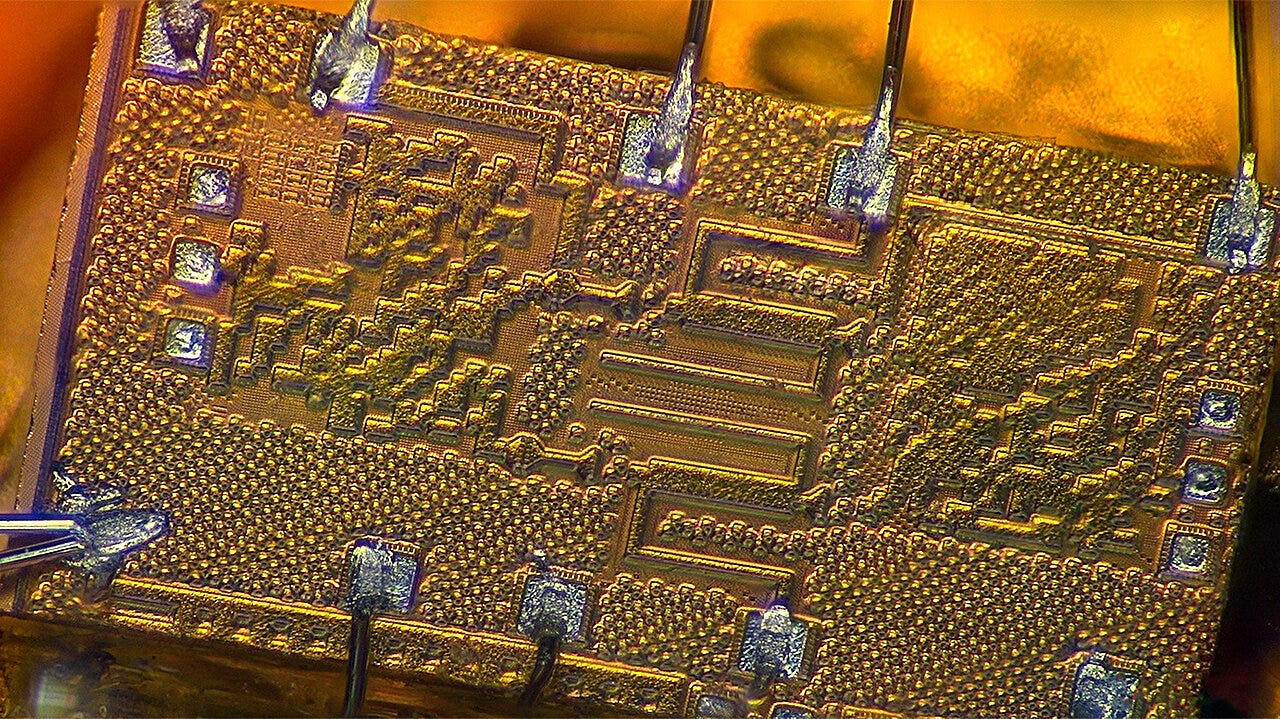
On a slightly weirder chip design note, researchers have used AI to create microchips, which compressed the time for new chip design to hours—down from weeks. The results looked strange, with the lead researcher saying that “the designs were unintuitive and unlikely to be developed by a human mind. But they frequently offer marked improvements over even the best standard chips.” They appear almost random in their shapes, “but when connected with circuits, they create previously unachievable performance.” This is likely just the beginning of a fascinating change in how computer chips are designed, and eventually we may get to the point where we don’t really even understand how they work, just that they do. (SciTechDaily, Dr. Singularity) (Tech Xplore) (Princeton Engineering)
Space
South Korean researchers are working on four satellites that when working together will give enhanced resolution and imaging of supermassive black holes. They’ll accomplish this by avoiding interference from Earth’s atmosphere, and having a longer baseline—the width of their orbit—and therefore better resolution than Earth based telescopes. (@ExploreCosmos_)
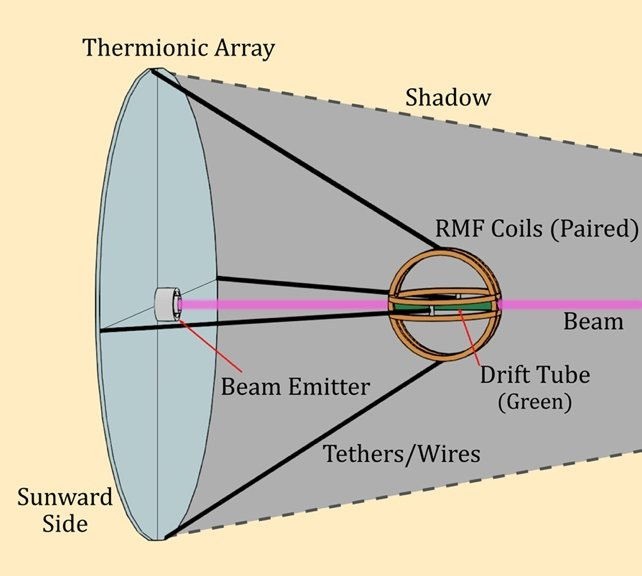
A new mission proposal has been mooted to send a one ton probe to Alpha Centauri using solar generated relativistic electron beams as a means of propulsion. Unlike previous concepts with tiny probes, this one could shoot much heavier probes out to our nearest stellar neighbor at around 10% the speed of light—carrying a much larger suit of scientific instruments. The neat bit is that electrons are easy to accelerate to near the speed of light. The problem is a tight beam of electrons should spread out rapidly due to their repelling each other (because they all have the same charge). But because they’re moving at relativistic speeds time slows and the beam doesn’t expand much over vast distances, making it usable as a means of propulsion. (Los Alamos National Laboratory, via @ExploreCosmos_) (Phys.org – for more details)

Data from basalt brought back from the Moon by the Chang’e-5 mission strongly suggests that the Moon possessed a weak magnetic field until at least 2 billion years ago. The implications are that our Moon may have had a magnetic dynamo caused by thermal convection in the lunar interior, leading to volcanism. Maybe even (though they don’t say it in the article) allowing a very thin atmosphere in the earlier days? (Science Advances)
Sifting through data from NASA’s K2 space telescope mission, astronomers have found a Super Earth sized planet with a density similar to lead. A planet so dense suggests that it consists of the remains of a larger planet whose outer, rocky layers have been stripped away. As the planet orbits its star in just 21 hours, this stripping could have been due to ferocious bursts of radiation from the star over billions of years. Yikes. (SciTechDaily)
NASA has suggested a couple plans to achieve their goal of returning samples to Earth from Mars. Option 1 is using a similar approach to what’s been done before, including the sky crane method used for the Curiosity and Perseverance rovers. Option number 2 is using commercial partners to deliver “deliver the lander payload to the surface of Mars.” Both options rely on using the European Space Agency’s Earth Return Orbiter to get from Mars orbit back to Earth. The biggest problem here is that they won’t get the samples until 2035 at the earliest, and China is likely to beat them to it, bringing their own samples back to Earth first. A possible alternative: how about SpaceX just sends humans to Mars around 2030, and they pick up some rocks to bring back while they’re there? I like that plan better. (NASA) (Scott Manley)
AI, Energy, Engineering, & Physics
Dark Energy might not exist, according to a new study published in the Royal Astronomical Society. Dark Energy is used as a placeholder for the unknown force powering the continued—and perhaps accelerating—expansion of the universe. But some new evidence suggests that this expansion might be “lumpy” and not uniform. This new study theorized it to be caused by the fact that gravity slows down time, so therefore time passes more slowly in galaxies and galaxy clusters, and faster inside giant cosmic voids. Potentially billions of years more would pass in voids, thus allowing more expansion of space there than within the confluence of mass that are galaxy clusters. Further data needs to be gathered, but this could be the answer to a very pesky mystery, and it would be (to me anyways) a pretty cool solution. (Royal Astronomical Society)
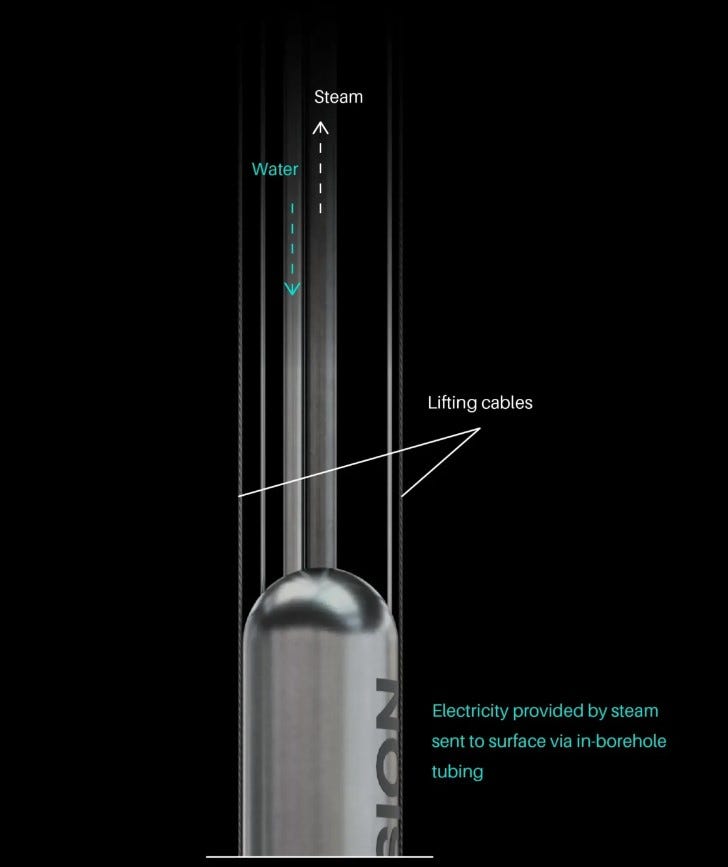
Two companies have put forward a plan to build and then bury small modular reactors (SMRs) a mile underground. The reactors will be tiny, small enough to be lowered down through 30 inch wide boreholes. Depth would provide containment and pressure, eliminating much of the shielding and safety systems needed at surface. They hope to produce power for 5-7 cents a kWh, with the first reactors starting up in 2029. (Interesting Engineering)
Sam Altman of OpenAI has announced that the company knows how to build AGI (Artificial General Intelligence). He didn’t elaborate much, but said that he was talking about AGI as it’s traditionally understood—which in my mind means something like JARVIS from Ironman. We shall see, but one thing is for certain, AI is advancing a lot faster than most people realize. An AGI really could be here before we know it. (Sam Altman)

Advanced Micro Devices (AMD) is an American company that makes advanced computing and graphics technologies—things like CPUs and GPUs). They’ve just announced they’ll be releasing an AI processing chip to compete with NVIDIA, who is currently the leader in the field. They say that their new Ryzen AI Max+ 3954 chip will provide 2.2x better performance than Nvidia’s standard GPU used for AI training—all while using less power. The battle is on! (Dr. Singularity)
China has released what they say is the world’s most powerful electronic warfare design software, 15x faster than what the U.S. has. And, they’ve released it publicly, for free. I feel like this is just an attempt to sow chaos, and to be honest I’d take these estimates with a grain of salt. No way China is releasing the very best they have, or that America’s very best is public enough to be measured against accurately. Still, not cool guys! Only way to deal with this is to out science, out engineer, and out build them. Accelerate! (Interesting Engineering)
Medicine
The days of obesity epidemics in Western countries might be numbered, with a new ‘vaccine’ for preventing weight gain coming down the pike. In the study, mice were given weekly injections of a beneficial bacteria called Mycobacterium vaccae, commonly found in cow’s milk and soil. The idea is that this bacteria falls into the “old friends” category, that has developed to live around and inside humans, while providing beneficial services like immune system regulation and reducing inflation. Our modern lifestyles have generally removed us from these old friends, leading to numerous health problems—including weight gain. Mice given the bacteria kept weight off, even when fed an unhealthy diet, hopefully the same could work for humans. Preferably in oral form instead of injections. Also, let your kids play in the dirt and go visit farms, exposure to beneficial bacteria will help them out later in life. (Medical Xpress)
Scientists have uncovered a genetic signature of 177 genes “shared across multiple cancer types” that drives cancer metastasis—where cancer spreads from its original site to other locations in the body. The finding challenges the idea that the mechanism of metastasis differs significantly between cancer types, and may pave the way for treatments that are broadly effective against multiple cancers. (Medical Xpress)
Bioengineered (grown) blood vessels are being tested in humans, with the early results being very promising—including “superior infection resistance and better limb preservation.” Compared to previous studies using synthetic grafts, 91.5% of the grown vessels remained open and functioning (versus 78.9%), and only 4.5% of patients later required amputation, compared to almost a quarter who received treatment with synthetic grafts. (Medical Xpress)
Australian neuroscientists have found that using low intensity ultrasound on the brains of mice with an Alzheimer’s disease like condition can “boost cognitive function without clearing amyloid plaques.” The mechanism is unknown, but it’s hypothesized that maybe it improves brain function by enhancing synaptic activity. Early human trials have been done by the team, but annoyingly the article didn’t say what (if any) improvements were seen. The impression I get though is that it was effective. (Nature)
CRISPR gene therapy has just been used to correct muscular dystrophy, and regrow muscle in mice. It’s not a complete cure yet, as the process of removing, editing, and transplanting the cells would need to be done for each muscle—there’s more than 600 in the body. But it’s encouraging progress, and if paired with an efficient delivery method, it could do in vivo gene editing and lead to a functional cure. (Medical Xpress)

Here’s some charts showing the progress from 1950 to almost today against childhood cancer. It’s been a process measured over decades, but slowly deaths from childhood cancer are becoming less common. Excellent news, we need to work on dropping those numbers to zero. (Crémieux, Our World in Data)
Biotech & Agriculture
A new tool could make genetic engineering easier by allowing scientists to edit multiple genes simultaneously—allowing complex genetic disorders to be tackled in one shot. “We wanted to build a single platform that could precisely and efficiently edit DNA as well as upregulate and downregulate gene expression,” said one of the study’s authors. It works by “combining an improved ‘Prime Editor,’ capable of modifying DNA sequences, with previously invented technologies for increasing and decreasing the expression of genes.” In laboratory tests with human cells, the tool has been preforming perfectly. Hopefully we start seeing clinical applications soon. (Phys.org)
Weird & Wonderful
Using tiny trackers, researchers at the Max Planck Institute of Animal Behavior have discovered that some migrating European bats actually “surf” the warm fronts preceding storms, using “the strong winds generated by the front to get a boost to their destination—and expend less energy in the process.” (Smithsonian Magazine)
A new AI is now able to “accurately predict the activity of genes within any human cell, essentially revealing the cell's inner mechanisms.” This could fundamentally change our understanding of biology, turning it “from a science that describes seemingly random processes into one that can predict the underlying systems that govern cell behavior." To show you just how amazing this is, the researchers used their AI to predict the result of a mutation in a type of childhood leukemia—which at the time was unknown. It predicted that the mutation disrupted the interaction of two transcription factors “that determine the fate of leukemic cells.” Lab tests confirmed that AI was correct, which means this can be used to uncover brand new knowledge. This technology is changing the world for the better. (Phys.org) (Dr Singularity)
In edition #20 I mentioned a chimeric gene found in poplar trees. I just wanted to add a few thoughts I had since. This is essentially natural genetic engineering, where the basic genetic programing giving it the capacity to occur must already be present (some implications there). The result though in this case is a new gene composed of gene segments from three separate organisms—a tree, an ant, and a bacteria—representing very divergent branches on the tree of life. It’s a natural example of what those who object to GMOs often have a problem with: the idea of mixing the genetics of different organisms. But apparently it happens in nature anyways, so they really don’t have a leg to stand on.
Photos & Videos


The BepiColombo probe has just made a close flyby of the planet Mercury. It will actually settle into orbit in late 2026, but in the meantime, enjoy these spectacular closeups! Incredible as it may sound on a planet where it gets up to 430°C (800°F) during the day, but there's likely ice in some of these permanently shadowed craters near Mercury's north pole. Maybe sites for future cities? Mercury actually has the ~same gravity as Mars. I used to think Mercury wasn’t a good place for future colonies, now I’m thinking perhaps it’s got some appeal after all. Water, lots of metals, you could build another branch of human civilization there. Solar power would work really, really well! (BepiColombo)

Have a look at this beautiful flyover of a green aurora from the International Space Station (click on image to go to video on X). (Don Pettit)

The Associated Press recently did an article on the reemergence of Art Deco as a popular style. I think it’s got a very techno-optimist, e/acc vibe, which I love to see. Picture isn’t their though. (The Associated Press, via Aaron Slodov)
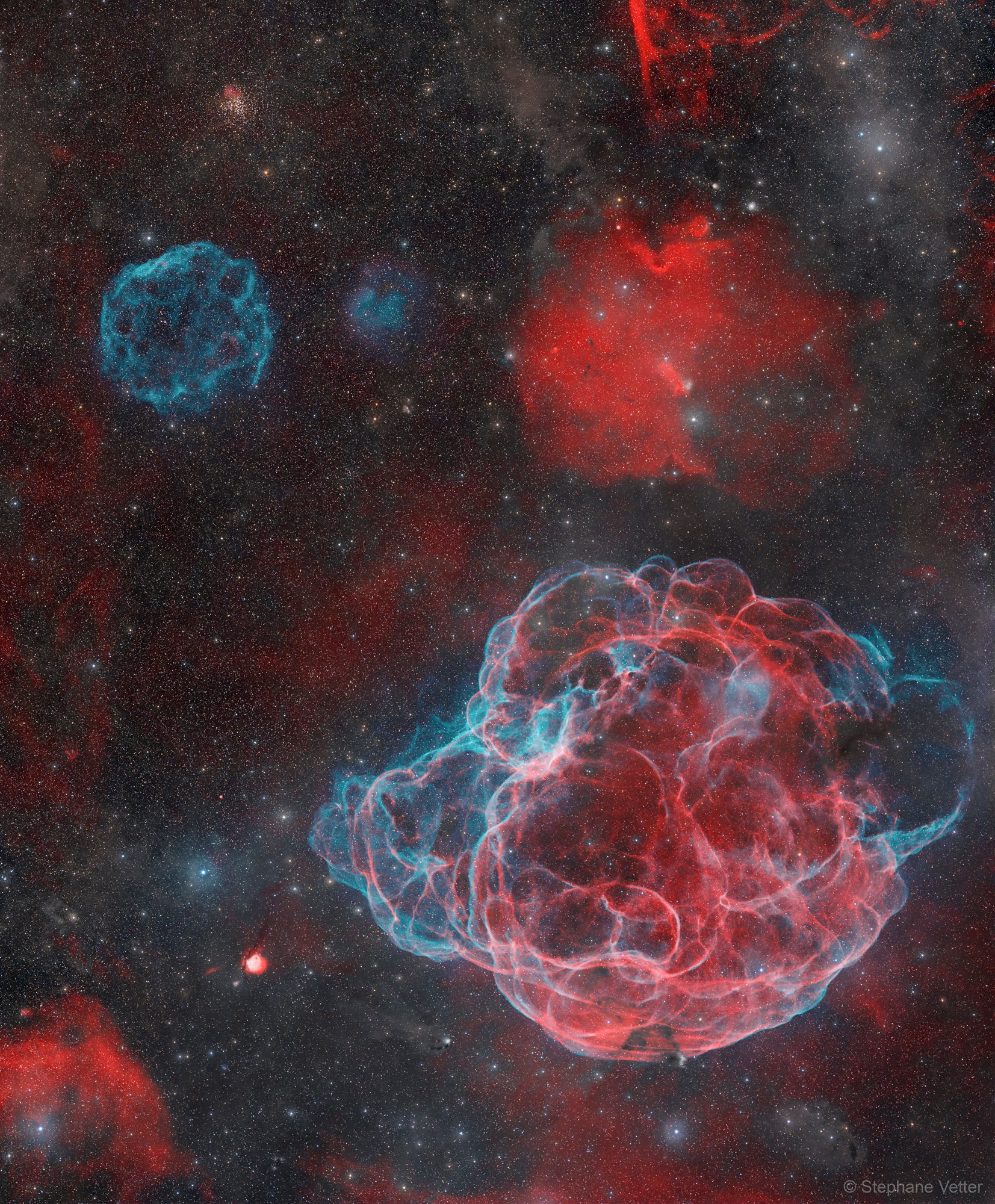
Some beautiful supernova remnants. The blue “soccer ball-looking nebula toward the upper left” is SNR G179.0+02.6, which exploded around 50,000 years ago. The Spagetti Nebula is the biggest in the image (lower right), formed from a star that went supernova about 40,000 years ago. They’re actually about the same size, but the difference in distance to Earth gives the effect you see here. (Astronomy Picture Of The Day)
Recommendations & Reviews
Kurzgesagt has released another one of their excellent videos, and you should definitely go and watch it. It’s on a relative of black holes, and explains gravastars, “Black Hole’s Evil Twin.” In a nutshell, they’re postulated as a cosmic monster some stars could turn into instead of becoming a black hole when they die. There’s no singularity—instead, gravastars have a physical shell made of the hardest material physically possible, containing an “empty” interior full of vacuum energy compressed to the highest level allowed by physics. It’s a fascinating video, and there’s actually a way to test it: when two black holes collide, the “sound” of their gravitational waves is deep and resonant, sort of like a bass drum, “a deep thump that stops quickly.” Two gravastars would be more like a gong, “leaving subtle echoes behind.” We’re listening, and if they do actually exist, our gravitational wave detectors might pick them up. Now that would be pretty cool. (Kurzgesagt)
I’ve been seeing a lot happening in medicine and biotech recently, here’s some of the highlights from 2024.
It was an incredible year for biotech, and I feel like we're just getting started! Have a read through this edition of Neural NeXus by David Kingsley. In it, David covers what he feels are the top 5 biotech breakthroughs in 2024.
5) New HIV prophylactic: capsid inhibitor prevents 100% of infections in Phase-3 human study.
4) Innovation in Induced Pluripotent Stem Cells Reverse type-1 Diabetes in Human Study.
3) Semantic Decoding Translates Thoughts into Action (i.e., brain computer interfaces).
2) Next-Gen AI Models for Drug Discovery (things like AlphaFold).
1) GLP-1 Receptor Agonists Advancements and Expanded Applications Are Changing the Trajectory of Obesity and Addiction. (Neural Nexus)
Have a read through the biotech honorable mentions from another publication, BioDodo, where he covers: Advancements in xenotransplantation - First lab-grown kidneys transplant, targeting genes to combat aging, mRNA editing, cell therapies for autoimmune diseases, bacteriophage therapy, and more. (BioDodo)
That’s it for this week, but Techno-Optimist will be back in your inboxes next week, so don’t forget to check. Thank you all for reading—and until next time, keep your eyes on the horizon.
-Owen
Great roundup! I listened to the audio version while at the gym and found myself constantly pausing to take notes. I love the idea that the carbon from outside the galaxy could partially make up our bodies.
Also, it's an honor to be featured as a highlight!
I may be one of the people who is eventually sorry for it, but for me, AI has so much potential for so much good that I can't help but to be excited. I even wish I were a bit younger because I think the future could be amazing. And golden. It could also be dark, but it doesn't have to be.